
Sludgineers Best Upgrades and the Optimal Upgrade Order
The best Sludgineers upgrade order, short version: buy energy capacity first, cash and resource multipliers second, refinery automation as soon as it is affordable, and raw suction power last. The reason is that Sludgineers gates early jobs on energy, and multipliers compound across every remaining job while flat power does not.
Key facts
- Priority 1
- Energy / battery capacity
- Priority 2
- Cash & resource multipliers
- Priority 3
- Refinery throughput, then automation
- Priority 4
- Object Bonus value
- Priority 5
- Suction power and range
- Node ranks
- Typically 1–3 per node
- Costs
- Cash and refined resources
- Favourites
- Right-click a node to pin it
How the Sludgineers upgrade tree works
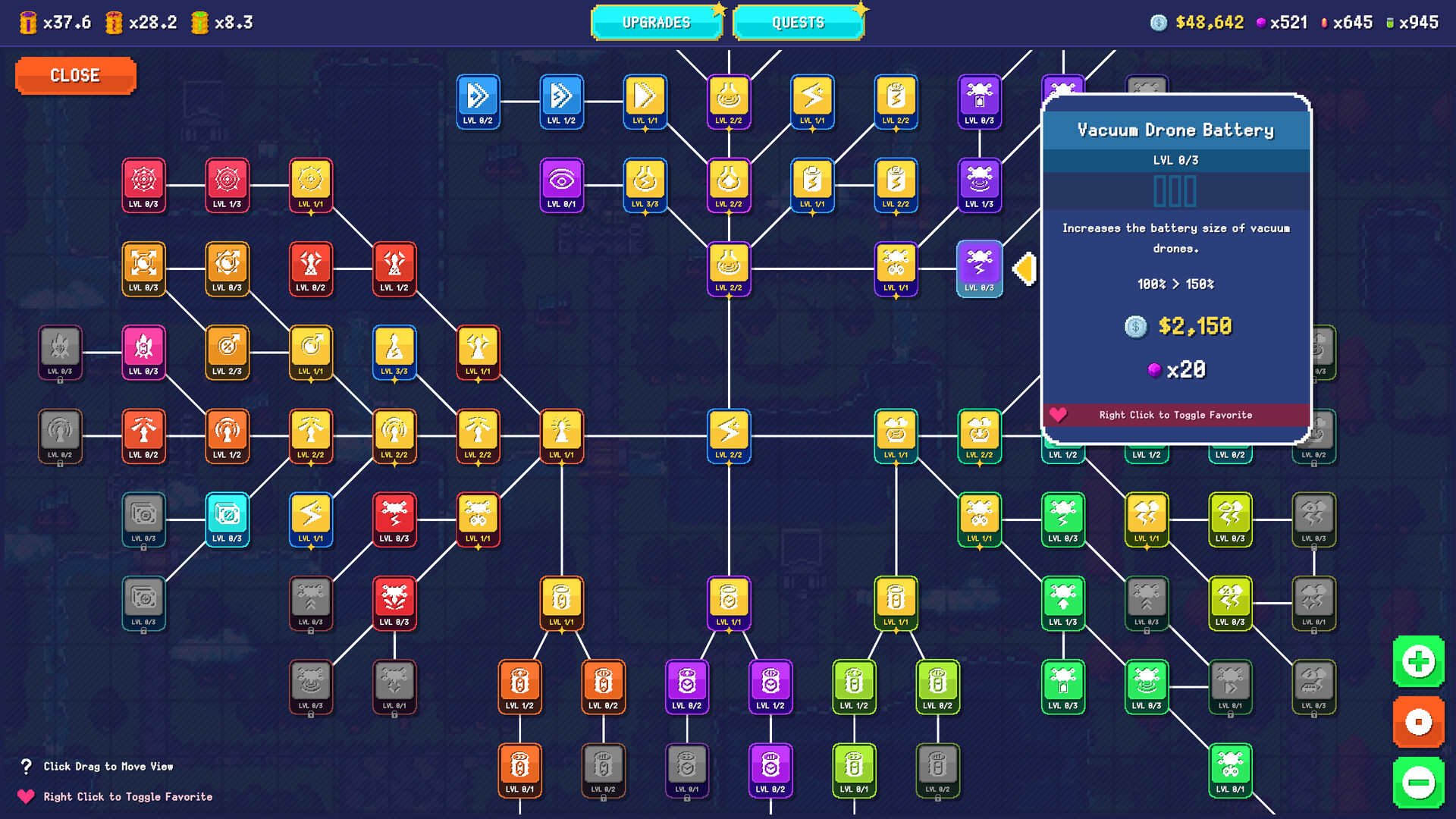
The upgrade screen in Sludgineers is a large, drag-to-pan node graph. Nodes are colour-coded by category and connected by prerequisite lines, so you unlock outward from what you already own rather than cherry-picking anywhere on the board. Most nodes have multiple ranks — commonly shown as LVL 0/1, 0/2 or 0/3 — and each rank costs more than the last.
Two details worth knowing immediately. First, nodes cost cash and refined resources together, so the refinery is not an optional side system — it directly gates your tree progress. Second, right-click toggles a node as a favourite, which is how you keep track of what you are saving for on a board this size.
The priority order, and why
1. Energy and battery capacity
Buy these first, without much hesitation. In early Sludgineers your jobs end because the Energy Level meter empties, not because you ran out of sludge. Every extra point of capacity is directly more Job Progress, and Job Progress pays in discrete milestone jumps. Full reasoning on the energy guide.
2. Cash and resource multipliers
The Job Complete screen applies a multiplier to your Completion Cash — you can see it stated explicitly, e.g. ×1.1. Anything that raises that number improves every job you will ever play from now on. That is what compounding means, and it is why multipliers outperform flat upgrades over a 5–6 hour game. The same logic applies to resource yield multipliers, which accelerate every subsequent tree purchase.
3. Refinery throughput, then automation
Refined resources are half the currency of the upgrade tree, so a refinery that processes faster makes the whole tree cheaper in real terms. Then, the moment refinery automation is within reach, buy it. It is the largest single quality-of-life jump in Sludgineers and it removes a manual chore that otherwise taxes every loop. See refinery automation.
4. Object Bonus value
Object Bonuses are already a large share of a well-played job's income — in our payout screenshot they were $2,320 against $7,750 of Completion Cash, roughly a quarter of the total. Upgrades that raise what uncovered objects pay scale with a behaviour you should be doing anyway.
5. Suction power and range
Not useless — just later. Raw power is a throughput upgrade, and throughput only becomes the binding constraint once energy is comfortable. Once you have capacity to spare and jobs are ending with energy left over, power and range become the correct purchase and stay so for the rest of the game.
The diagnostic that beats any fixed list
Upgrade guides go stale because balance patches move numbers. This does not. After each Sludgineers job, ask one question: what stopped me?
| What ended the job | The constraint | Buy this next |
|---|---|---|
| Low Energy warning, well short of 100% | Energy | Battery / energy capacity |
| Cleared the job with energy to spare | Throughput | Suction power and range |
| Cleared it, but the payout felt small | Multipliers | Cash and resource multipliers |
| Can't afford nodes despite good cash | Resources | Refinery throughput and yield |
| Everything's fine but it's slow going | Automation | Refinery automation, then drones |
Unlocking the hi-tech tools
Two headline unlocks sit deeper in the Sludgineers tree: vacuum drones and air purifiers. The developers confirmed both as full-release, later-game tools. Drones then open their own sub-branch — the Vacuum Drone Battery node alone runs three ranks, scaling 100% to 150% and costing $2,150 plus 20 refined resources at the rank we observed.
Do not detour toward drones before your fundamentals are in place. They multiply your throughput, and multiplying a weak throughput gives you a slightly less weak throughput. Get energy and multipliers sorted, then invest. See drones and air purifiers.
Common upgrade mistakes in Sludgineers
- Rushing suction power. The most common error, for the reasons above.
- Ignoring the refinery. Resources gate tree purchases as hard as cash does. A cash pile you cannot spend is not progress.
- Spreading thin across every branch. Ranks get more expensive as you climb, but effects compound within a line. Finishing a good line beats rank 1 of six lines.
- Not using favourites. Right-click to pin your target. On a board this size, wandering is how you end up buying whatever is nearest instead of what you wanted.
- Saving cash. There is no interest mechanic in Sludgineers. Idle money earns nothing; spent money compounds.
Sludgineers FAQ
What is the best upgrade in Sludgineers?
Early on, energy and battery capacity, because the Energy Level meter is what ends most Sludgineers jobs. After that, cash and resource multipliers give the best return because they improve every remaining job rather than just the current one.
Should I buy suction power in Sludgineers?
Yes, but later. Suction power is a throughput upgrade and only becomes the binding constraint once you have enough energy capacity to finish jobs. If your jobs end on a Low Energy warning, buy battery capacity instead.
What order should I unlock the Sludgineers tech tree?
Energy capacity, then cash and resource multipliers, then refinery throughput and automation, then Object Bonus value, then suction power and range. Drones and air purifiers come after your fundamentals are in place.
Do Sludgineers upgrades cost resources as well as cash?
Yes. Upgrade tree nodes in Sludgineers cost both cash and refined resources, which is why refinery throughput matters as much as raw income.
Related Sludgineers pages
Fact-checked against the official Steam store page, the developer FAQ thread and in-game screenshots. Last verified .