
Sludgineers Refinery Guide: Processing and Full Automation
The Sludgineers refinery is the industrial complex you build on the overworld map. It converts the raw sludge you haul home into the refined resources that upgrade tree nodes demand alongside cash. Refinery automation is a full-release feature — it is not in the demo — and it is the single biggest quality-of-life jump in the game.
Key facts
- What it is
- Your processing complex on the overworld map
- Input
- Raw sludge collected on jobs
- Output
- Refined resources (multiple types)
- Why it matters
- Tree nodes cost cash and resources
- Automation
- Full release only — not in the demo
- Quest tie-in
- Quests ask you to refine set quantities
What the refinery does
When you finish a Sludgineers job, the payout screen lists Resources Collected alongside your cash — several distinct barrel types, each with its own running total. Those are raw materials, and on their own they do not buy anything. The refinery is what turns them into the refined resources that upgrade tree nodes actually require.
This is the detail that catches new players out. In Sludgineers you cannot simply earn your way through the tree with cash. Node tooltips show two costs — a dollar figure and a resource quantity. The Vacuum Drone Battery node we photographed costs $2,150 and 20 refined resources. If your refinery is not keeping pace, your cash piles up uselessly.
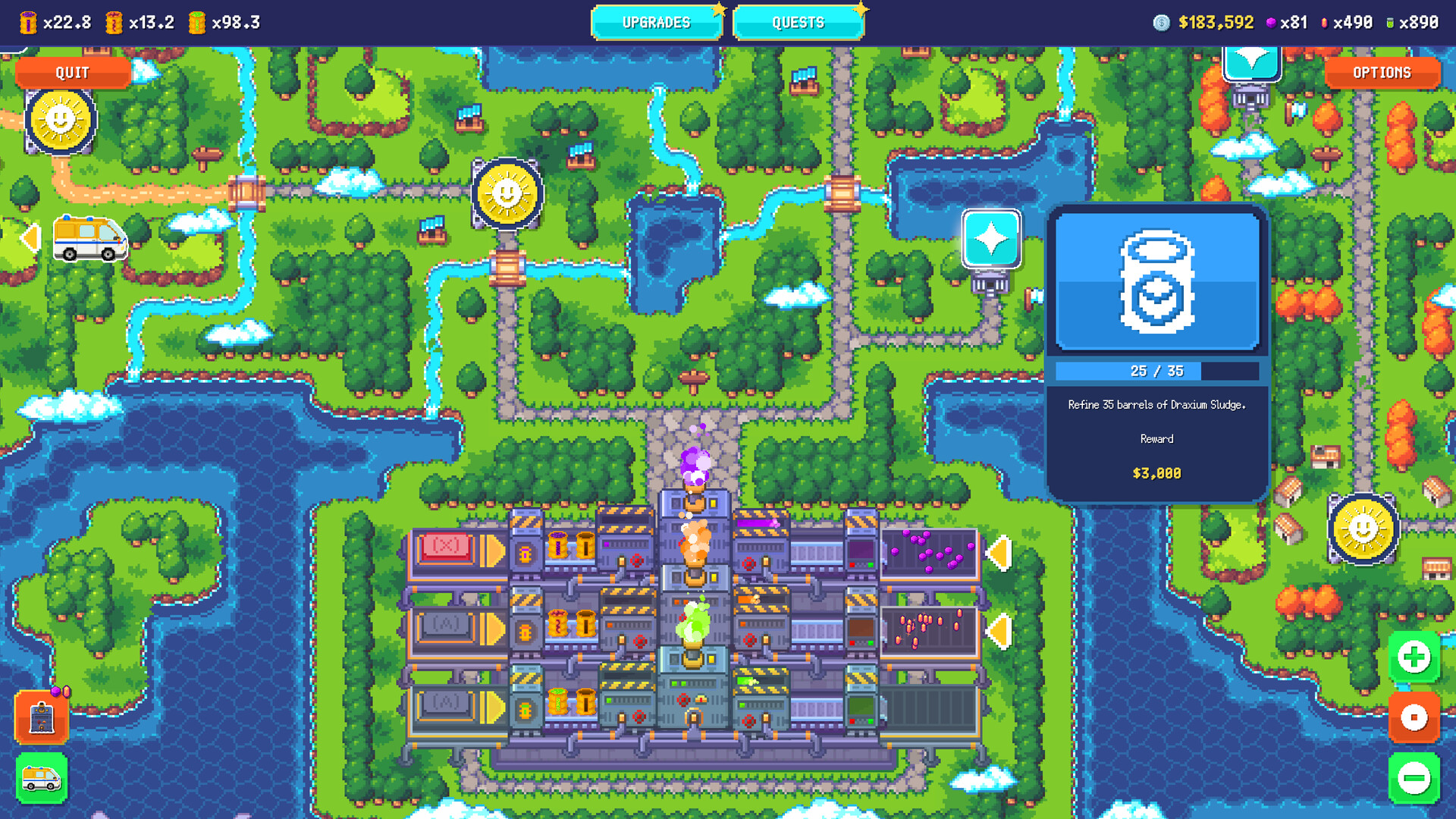
The refinery on the overworld map
Between jobs, Sludgineers shows the countryside as a connected map — roads, rivers, bridges, small settlements and job markers. The refinery is the large industrial structure you build and expand in the middle of it, laid out as rows of processing lines with conveyors, tanks and machinery.
Your resource totals sit in the corners of this screen: raw barrel counts with multiplier values in the top left, and cash plus refined resource counts in the top right. Watching those two sets of numbers diverge is how you know whether refining or collecting is your bottleneck.
Getting refinery automation
Refinery automation is confirmed by the developers as a full-release addition. Their launch announcement lists it explicitly among what the 1.0 version added over the demo, alongside drones, more pollution types and a larger map.
Before automation, refining is a manual step you return to between jobs. After it, the refinery processes on its own while you are out cleaning, which changes the pace of the whole game — you stop shuttling back and forth and start playing the loop the way it is designed to feel. This is why we recommend prioritising it the moment it is affordable in the upgrade order guide.
Refining and the quest board
The refinery is tied directly into Sludgineers quests. One observed quest read “Refine 35 barrels of Dracium Sludge”, tracked at 25/35, paying $3,000 on completion. That is a meaningful cash injection for processing material you were going to process anyway.
Named sludge types like Dracium Sludge mean the refinery is not a single undifferentiated converter — different pollution types produce different materials, and quests target them specifically. The full release added additional pollution types over the demo, which widens this system considerably. See sludge types and refined resources.
How to keep the refinery fed
- Check which resource is blocking you. Open the upgrade tree, find the node you are saving for, and read which resource its cost line demands. Right-click to favourite it so you do not lose it.
- Pick jobs that yield that pollution type. Different Sludgineers regions carry different sludge, so the job you choose determines what lands in your barrels.
- Clear completely. Resources Collected scales with how much of a job you actually finish, the same way cash does.
- Buy refinery throughput before hoarding. A faster refinery makes the entire tree cheaper in real time. It is an investment in every future purchase.
- Automate, then forget it. Once automation is running, the refinery stops being a decision and becomes background income.
Common refinery mistakes
- Treating it as optional. It is not a side system — it is half the currency of the upgrade tree.
- Chasing cash-only upgrades. If your resource counts are flat while your cash climbs, you are about to hit a wall.
- Delaying automation. Every job you play before automating costs you the manual round trip.
- Ignoring quest targets. Refining quests pay for work you are already doing.
Sludgineers FAQ
What is the refinery in Sludgineers?
The refinery is the industrial complex you build on the Sludgineers overworld map. It processes the raw sludge collected on jobs into refined resources, which upgrade tree nodes require alongside cash.
How do you automate the refinery in Sludgineers?
Refinery automation is unlocked through the upgrade tree and is a full-release feature — it is not available in the demo or the free browser build. Once unlocked, the refinery processes materials while you are out on jobs.
Why can't I afford Sludgineers upgrades even with lots of cash?
Because upgrade tree nodes in Sludgineers cost refined resources as well as cash. If your refinery output is not keeping pace with your income, cash accumulates while purchases stay locked. Invest in refinery throughput.
What is Dracium Sludge in Sludgineers?
Dracium Sludge is one of the named pollution types in Sludgineers. It appears in quest objectives such as 'Refine 35 barrels of Dracium Sludge', which pays a $3,000 cash reward.
Related Sludgineers pages
Fact-checked against the official Steam store page, the developer FAQ thread and in-game screenshots. Last verified .