
Sludgineers Sludge Types and Refined Resources
Sludgineers runs on two kinds of currency: cash, and refined resources. Jobs yield raw sludge in barrels, the refinery converts it, and upgrade tree nodes demand both — the Vacuum Drone Battery node costs $2,150 and 20 refined resources. Named pollution types such as Dracium Sludge are targeted directly by quests.
Key facts
- Primary currency
- Cash ($)
- Secondary currency
- Refined resources
- Raw form
- Sludge barrels, collected per job
- Refined types observed
- Three distinct counters
- Named pollution type
- Dracium Sludge
- Processed at
- The refinery
- Upgrade costs
- Cash and resources together
The two-currency economy
This is the single most important thing to understand about Sludgineers progression, and it is easy to miss for the first hour. Cash alone does not buy upgrades. Every node in the tree shows two cost lines — a dollar figure and a resource quantity. If either is short, the node stays locked.
The confirmed example: the Vacuum Drone Battery node costs $2,150 plus 20 refined resources at the rank observed. A player with $50,000 and no refined stock cannot buy it.
Raw sludge and the barrel counters
Finish a Sludgineers job and the payout screen lists Resources Collected beneath the cash breakdown — several distinct barrel icons with their own amounts. In one observed clear these read ×13.6, ×14.3 and ×3.2, three separate materials from a single job.
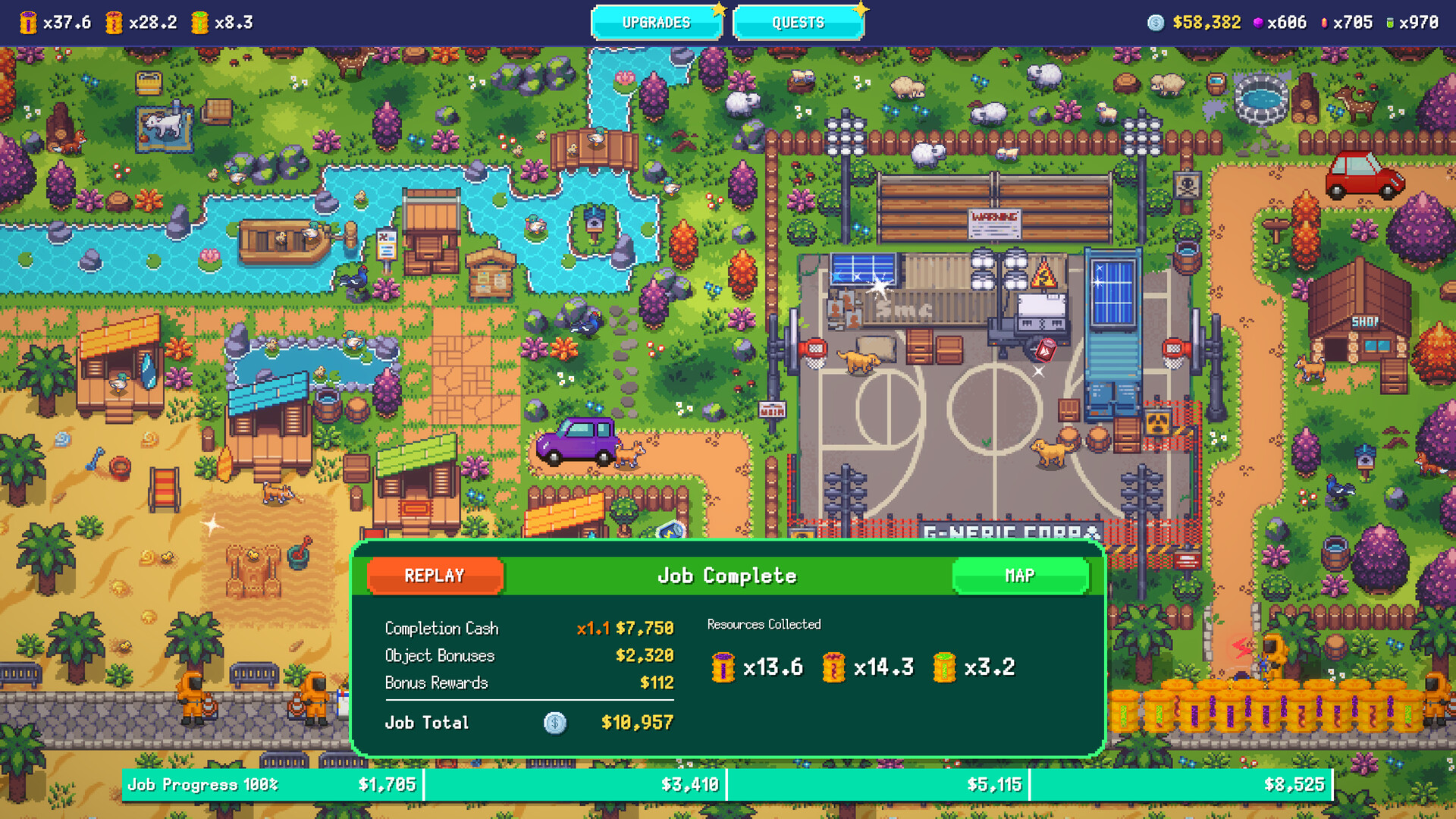
On the overworld map, matching barrel counters sit in the top-left corner with multiplier-style values (×22.8, ×13.2, ×98.3 in one screenshot), while the top-right corner carries your cash total alongside three coloured resource counts (×81, ×490, ×890 in the same shot). The two sets are the raw and refined sides of the same economy.
Three refined resource types
The top-right HUD in the Sludgineers meta screens consistently shows cash plus three colour-coded resource counters — blue, magenta and green. Those are the refined currencies the upgrade tree spends. Different tree branches lean on different colours, which is why a run can stall on one material while another piles up unused.
| Counter | Where shown | What it is |
|---|---|---|
| Cash ($) | Top right, coin icon | Universal currency, earned per job |
| Blue resource | Top right | One of three refined materials |
| Magenta resource | Top right | One of three refined materials |
| Green resource | Top right | One of three refined materials |
| Barrel counters | Top left | Raw sludge stock and rates, pre-refining |
Named pollution types
Sludge in Sludgineers is not generic. Quest objectives name specific materials — the confirmed example being “Refine 35 barrels of Dracium Sludge”, tracked at 25/35 and rewarding $3,000. A quest that names a material implies a system where materials are distinguishable, sourced from particular places, and worth targeting deliberately.
The developers' launch notes confirm the full release added additional pollution types over the demo, so the roster widens as you progress. Late Sludgineers jobs also visibly contain more than one contaminant at once — coastal and industrial scenes show a green tool beam distinct from the purple vacuum stream, consistent with air purifiers handling a different pollution class.
Managing the resource economy
- Read the node before you save. Open the tree, find your target, check which resource it wants, right-click to favourite it.
- Match jobs to materials. Different Sludgineers regions carry different pollution, so job selection determines your intake. See regions and jobs.
- Clear jobs fully. Resources Collected scales with completion the same way cash does.
- Buy refinery throughput early. A faster refinery makes the entire tree cheaper in real time.
- Automate as soon as you can. Refinery automation converts a manual chore into background income.
- Watch for lopsided stock. If one colour is stacking while another is empty, you are taking the wrong jobs for what you want to buy.
Why cash alone stalls out
The classic mid-game Sludgineers wall: you are earning well, your bank balance is climbing, and nothing in the tree is purchasable. That is always a resource problem, not an income problem. The fix is never more cleaning — it is refinery throughput, better-matched job selection, or automation. See the upgrade order guide.
Sludgineers FAQ
What resources are in Sludgineers?
Sludgineers uses cash plus three refined resource types, shown as colour-coded counters in the top-right HUD. Raw sludge is collected in barrels on jobs and processed into refined resources at the refinery.
What is Dracium Sludge in Sludgineers?
Dracium Sludge is a named pollution type in Sludgineers, targeted by quest objectives such as 'Refine 35 barrels of Dracium Sludge' which rewards $3,000.
Why can't I buy upgrades despite having money in Sludgineers?
Because Sludgineers upgrade nodes cost refined resources as well as cash. If your refinery output is behind your income, cash accumulates while purchases stay locked. Invest in refinery throughput or take jobs that yield the material you need.
How many pollution types does Sludgineers have?
A complete count is still being compiled. Dracium Sludge is confirmed by name, and the developers state the full release added additional pollution types beyond those in the demo.
Related Sludgineers pages
Fact-checked against the official Steam store page, the developer FAQ thread and in-game screenshots. Last verified .